
Matthew Taylor's Journal

Home Page: Matthew Taylor

Land O Lake, FL, USA
| Total Posts: 26 | Latest Post: 2017-04-27 |
| Table of Contents | RSS Feed |
The going got a bit slow here. Jerry's expert inspections often began with "close, but...." Cole even got fired once. He took it well. While my technique improved, so did my ability to tell what wasn't going to fly. My own inspections started to begin with "close, but..." Cole kept the body filler sandings on the floor swept up - and that was becoming a full time job. However, the body WAS taking shape. It seamed everywhere I touched, there was a mountain or valley - or the contour wasn't quite right, but, we stayed on it, and eventually...Jerry fixed it in a minute or 2. Well, it seamed that way...
The body was exposed metal, and although blessed with dry weather, the days were dragging by, and rust was a real concern. We still had allot of work on the bonnet to do, but it was decided we would get the rest of the car under primer, before we had to deal with rust mixed in with our new body work. I learned the proper way to tape and paper, and did that correctly - on the second or third try. We were all set for primer.

Tail Body Work Complete
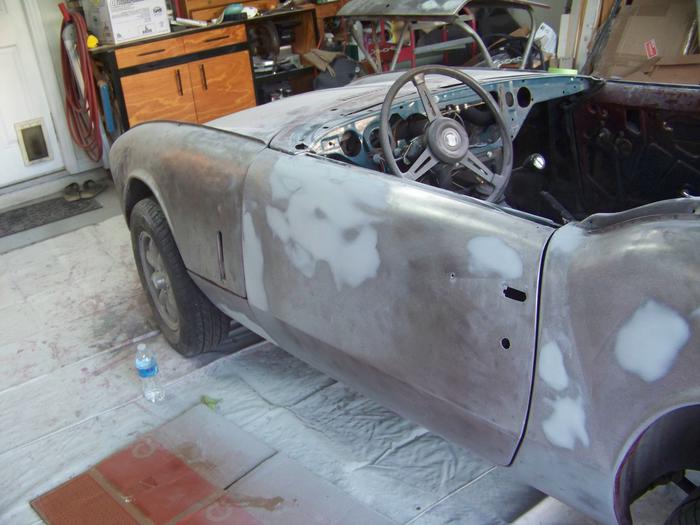
Door is ready
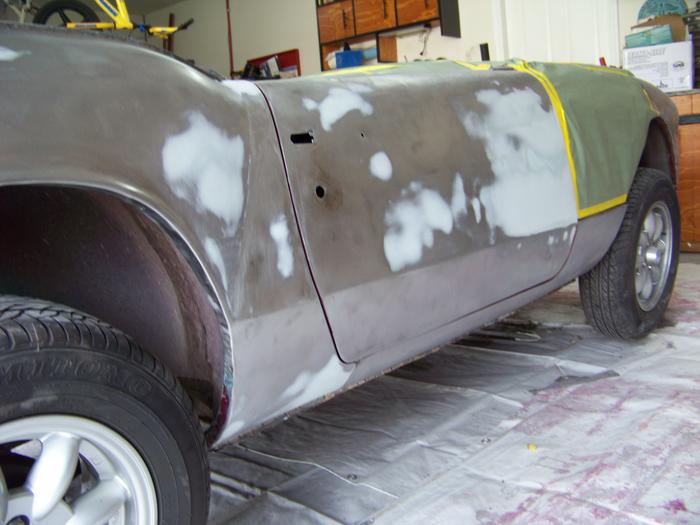
Right Side Done
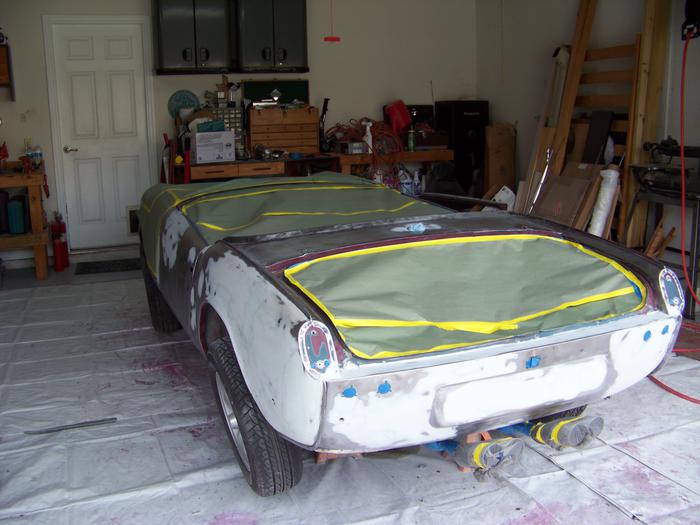
Ready to Prime

While the body work was stretching my patients, ability to learn, and Jerry's laugh lines, Cole and I decided to tackle some of the wood work. Now the dash in the 70 U.S. version had a plastic overlay - somewhere along the line, someone "upgraded" the dash to all wood (veneered plywood). Unfortunately, the years had taken a toll. I am no stranger to wood working, and replacing it would give me a chance to teach the boy a thing or 2 about wood working as well. The other item I had in mind was the steering wheel. It had started to decay, and would need replacement. I shared the idea with Cole - make them both out of the same thing to match. He loved it. The search for the correct wood was on. Cole is a particular fella, and the search lasted from early November until mid December. What he finally decided was the "right" color for his car - Walnut with a custom stain. So, I ordered enough Walnut to make a dash, steering wheel, and have enough left over for the shift knob. All back burner pieces, but, I needed a little break from the endless dents and dings on the body. The first item of business was to reduce the thickness from 1 1/4 down to 1/2 inch. Sure wish i had a plainer! I do have a bench mounted router - on the end of a cast iron table saw. So, we chucked a good sized bit, and took off about 3/8 at a time. Once it was down to size, we laid out the pattern (simply traced the pieces of the old dash), and cut it out with the scrawl saw. Cole went to work sanding and shaping to get it all just right. We figured out a way to cut the holes for the speedo and tach using the router as well. Staring with a hole saw, he used a Rabbet bit to cut about 1/2 way up. Then flipped the piece, and used the new cut as the guide for the bearing on a trim bit. We could adjust the finish hole size by changing the bearing size on the end of the Rabbet bit. We had a great productive day. But, then Jerry showed up and made me work again....

Final color

Raw stock

Cutting the big holes

Whats done to date
No comments have been posted yet...
Want to leave a comment or ask the owner a question?
Sign in or register a new account — it's free
Well, I can't say I have never beaten on a car with a hammer anymore. Jerry brought over his body tools, and explained how it all works. Several times. With examples. Then more slowly with simpler words....Well, you get the idea. We started on the drivers side quarter panel. Turns out, its not a "rear wing", its a quarter panel. And the one in the front is NOT a quarter panel at all. We have had many a discussion about what a "hood" really is, and I have heard Jerry say "Bonnet" twice so far. So, I can give some too - its a quarter panel. But, unfortunately, it was a bashed in mess of a rear wing - er - quarter panel. Jerry also explained that an inch of body filler is not a good thing, and we need to shape it as close to the correct shape as possible. And, FYI, its not called "Bondo" if it cost $90 a gallon with a discount... So, this lesson was a big one. We shaped the metal. Filled the holes and sanded it flat until we feathered the edges. And repeated, going out farther, until the shape was correct. I was just learning how to "see" with my fingers...and they had a lot to see. I was struggling with getting the highs and lows just right, and allot of filler had to come back off. Jerry repeatedly demonstrated that 20 minutes of his time was much much more productive than several hours of mine. Good thing the body was so dinged up, I had plenty of opportunities to learn how its done. Ya, real good thing....

First Layer
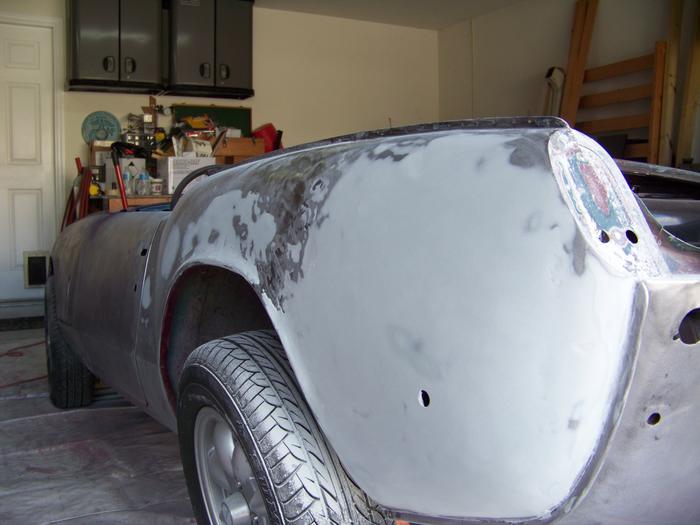
Second Layer

Third Layer
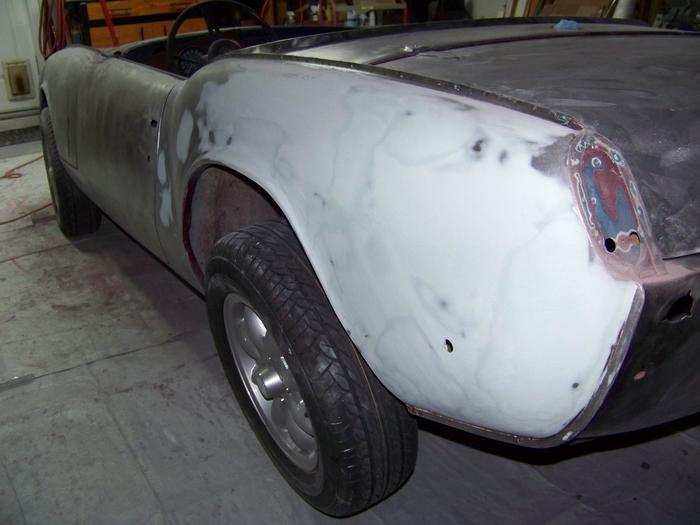
Final Shape
No comments have been posted yet...
Want to leave a comment or ask the owner a question?
Sign in or register a new account — it's free
We passed Jerry's inspection at this point - with some corrective action ("looks good, just get right here, and over here, and here, and here...." ). The next step was cleaning up what was left - time to put the DA sander and the shop air to the test. The smell of fresh paint getting hot filled the garage, as the compressor got a break in. Some of the dents proved to be so deep, I had to dig out the angle grinder to get down into the pockets. Jerry showed us why we were DA noobs a few times, but, we started to get the hang of it - as we finished. That's how most of this project went - we got really good at a particular step - as we finished that step. But, we were both learning, and Jerry kept us out of the ditch. To us, and our untrained eyes, the car looked incredible down to the metal. There was NO RUST anywhere. Jerry had said, we can fix anything, but NO RUST! So, that's what we had. I was thrilled. Jerry mentioned "allot of body work". Hmm, wonder what "allot" means...

Shop air and DA sander...
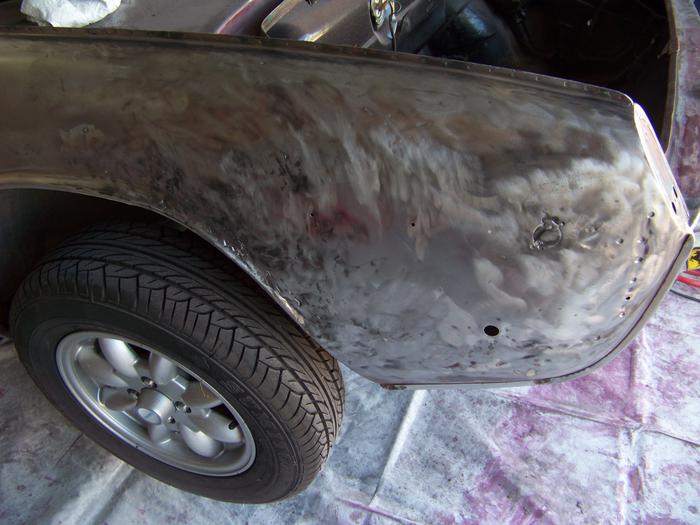
Body filler removed
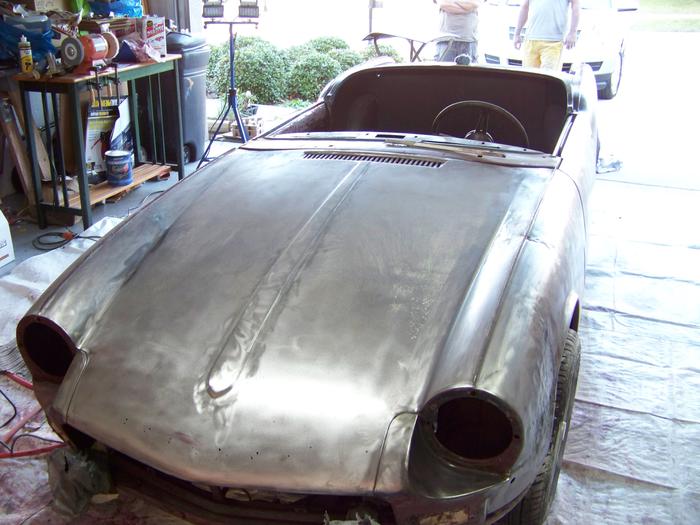
80 git DA sanded

100 2616
No comments have been posted yet...
Want to leave a comment or ask the owner a question?
Sign in or register a new account — it's free
My mentor for this project, Jerry, is no fan of the heavy commercial "aviation" paint strippers available today, especially for use in the home garage. Most of his "recommendations" were actually "requirements", and the choose of stripper was not optional - "Capt Lees Spra Strip". Capt Lees is far more gentle on fingers, fumes and clean up - its water soluble! It can be deactivated on the car with alcohol as well. Very easy to work with, not as easy to find. Jerry started using it when he was stripping Corvettes - it wont eat the fiberglass - and that's where I had to go to get it - online Corvette suppliers. I ordered 2 gallons - and we have 2/3 of one left. Cole and I hit it hard during the Thanksgiving break, and put the paint job in a cardboard box with a couple of putty knives. We used a drill and wire wheels to get in all the nooks and crannies. The only thing left on the car was a light residue of melted pigment that had hardened, and the deeper body filler pockets. And there were a ton of those.

There might be some body damage!

That filler is hiding something
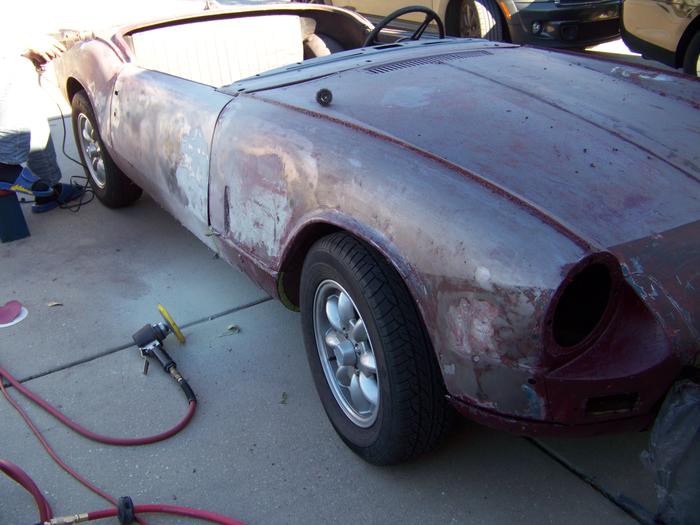
No rust, but lots of dents

No turning back now
No comments have been posted yet...
Want to leave a comment or ask the owner a question?
Sign in or register a new account — it's free
A friend of mine for high school still brings up the holes in my floorboards. There is just something about the Spits floor pans, they just really like to rot out. So, I was very happy to see this one had 2 actual floor pans! And originals at that. I attributed that to the fact the pans where magic, or the fact the car has been primarily in storage since 1980 or so. Since the later was more likely, I expected that the pans would soon rot right out the second we started driving it regularly. To prevent that, I put the boy to work with a wire wheel and a gallon of truck bed liner.
The next order of business was to get our "shop air" up to the level required to take the paint off a car, and put something back on. My 2 1/2 gallon compressor was not going to cut it. I picked up (ok, a fork lift picked up) a 60 gallon, 11.5 scfm (@90 psi) compressor. We ran 220 to it, and laid out a 50 foot sloping header, with drop legs drains, a regulator and a couple water separators. Problem was, to get the fall we wanted, we had to run it in the attic. Cole did a bang up job crawling around, and strapping it up nice and tight. Just ask him, he will tell you how good a job he did. If you have a system even slightly inferior, you wont have to ask him, he will volunteer the info on it. And now he knows why it pays to stay in school....
Planing on using a chemical stripper, we laid tarps on the garage floor, tape them down, and went to work removing everything from the car. Bagging all the hardware, and taping the bags to the main parts, we created a "file" system in the floor to ceiling shelving next to the work area. Everything came off quickly, and we took lots of reference pictures.
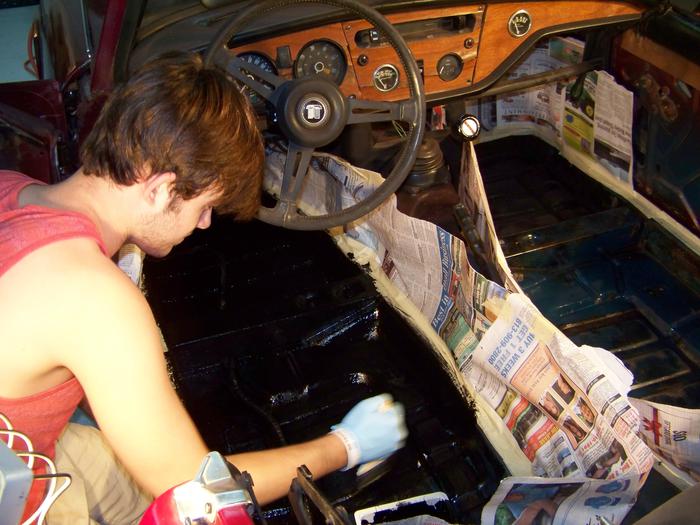
Bed liner
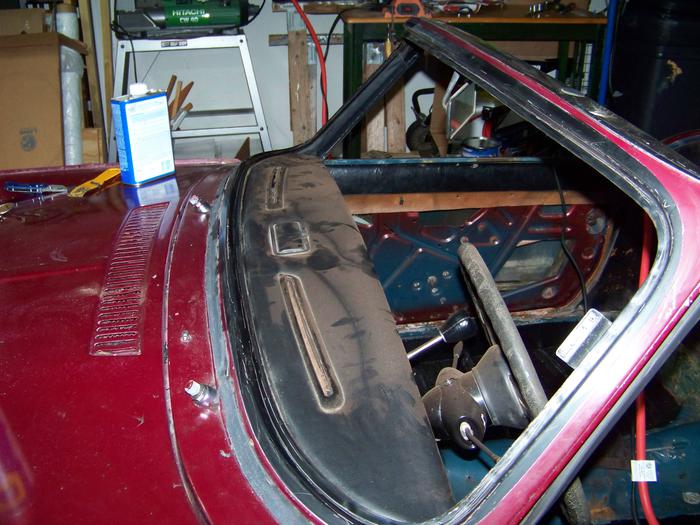
Removing the Windshield
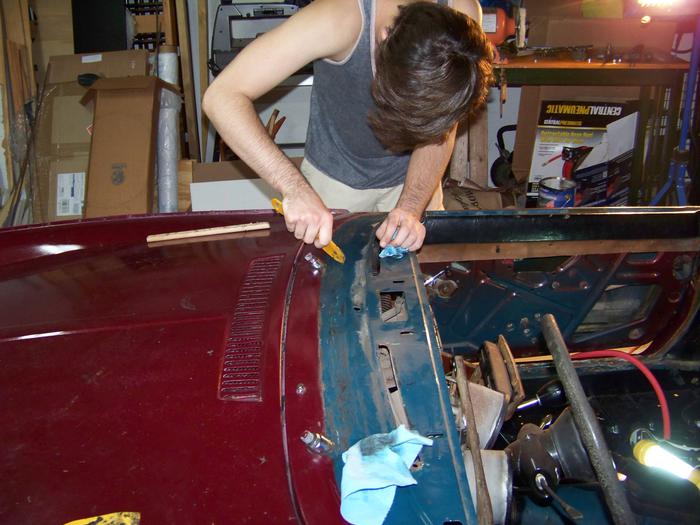
Removing the Windshield frame

Ready for paint removal
No comments have been posted yet...
Want to leave a comment or ask the owner a question?
Sign in or register a new account — it's free



No comments have been posted yet...
Want to leave a comment or ask the owner a question?
Sign in or register a new account — it's free